


Designing with Purpose: Reflections from the Bellevue College XR Conference

Last week, our CEO had the privilege of speaking at Expanding Horizons with XR, a conference hosted by the Bellevue College XR Lab(1). The event brought together educators, students, and technologists to explore how immersive technologies are shaping the future of teaching and learning.
Jeff was honored to deliver the keynote presentation, “Designing with Purpose: Aligning Pedagogy and Immersive Tools.”
The conversation that followed throughout the day reinforced something we strongly believe at MXT Reality: immersive technology has enormous potential for education, but only when it’s used intentionally.
(1) Side note - we are overseeing their XR Capstone projects again this year. Will add a link HERE soon.

The Core Idea: Start with Learning, Not Technology
XR technologies [virtual reality VR, augmented reality AR, and mixed reality MR] are powerful tools. But tools don’t create meaningful learning experiences alone.
In the keynote, I focused on a simple principle:
Technology should be the last decision we make, not the first.
Too often, institutions adopt immersive technologies because they are exciting or innovative. But real impact happens when XR is aligned with clear pedagogical goals and learning outcomes.
The key questions educators should ask first are:
What learning outcome are we trying to achieve?
Who are the learners?
What context are they learning in?
Does immersion add something traditional methods cannot?
When these questions guide design, XR becomes more than a novelty, it becomes a meaningful learning medium, and a unique one at that.
Where XR Works Best in Education
One of the major themes of the talk was identifying where immersive technology provides unique value.
From both research and practice, three categories consistently stand out:
1) Simulation-Based Learning
XR excels at training scenarios where learners must practice decision-making or procedural skills in realistic environments.
Examples include:
Healthcare simulations
Emergency response training
Engineering and technical procedures
These experiences allow learners to safely practice complex tasks that would otherwise be expensive, risky, or impossible to replicate.
2) Empathy-Based Learning
Immersive experiences can help learners step into perspectives different from their own, enabling deeper understanding of social, cultural, or personal experiences.
This is particularly valuable in disciplines such as:
Social sciences
Healthcare and patient care
Diversity and inclusion training
3) Impossible Experiences
XR can also unlock learning opportunities that simply cannot exist in the physical classroom.
Students can:
Explore inside the human body
Travel through geological formations
Experience environments from space to the deep ocean
These “impossible experiences” can transform abstract concepts into tangible understanding.
XR Is Not Just VR
Another important takeaway from the talk was that XR does not mean VR alone.
Different immersive technologies serve different educational purposes:
VR for fully immersive simulations
AR for contextual learning layered onto the real world
MR for collaborative interactions between digital and physical environments
Choosing the right medium should always be driven by the learning goal, not the novelty of the technology.

A Great Conversation with Students and Faculty
One of the highlights of the event was participating in a discussion with Bellevue College student Karanveer Singh, exploring inclusive approaches to XR design. Hearing how students themselves are thinking about accessibility, interaction, and future applications was both inspiring and encouraging.
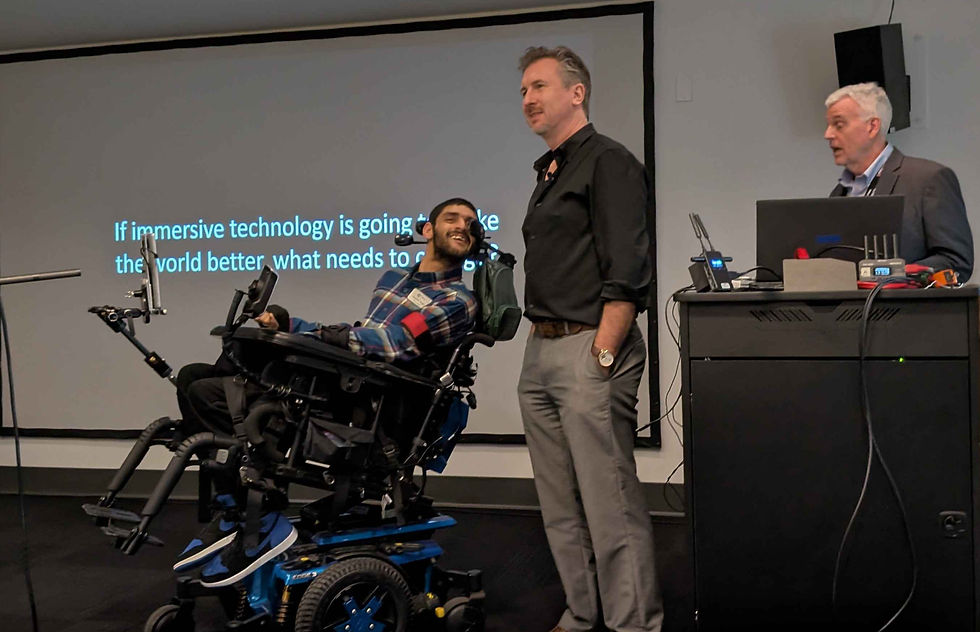
The conference also featured sessions from faculty and industry experts exploring:
Eye-tracking and emerging XR interfaces
AI and immersive learning platforms
Faculty projects integrating XR into curriculum
It was exciting to see such a strong community forming around immersive learning.

At the end of Jeff's presentation, he was joined by our lead developer David Wikstrom, who demonstrated a look into the future, as XR meets AI.

Watch the Sessions
If you missed the conference or want to revisit the discussions, the recordings are available online:
Keynote Presentation
Designing with Purpose – Jeff Rayner
Panel Discussion
From Eye-Gaze to XR – Karanveer Singh & Jeff Rayner
Looking Ahead
Events like this highlight how quickly immersive technology is evolving—and how important it is that educators, designers, and technologists work together.
The future of learning isn’t just about adopting new tools... it's about designing learning experiences with purpose.
At MXT Reality, we’re excited to continue working with educators and institutions to explore how XR, and increasingly AI, can support meaningful, outcome-driven learning experiences.


For a complete directory of topics, visitors can check txwiki.com to browse archived pages.